
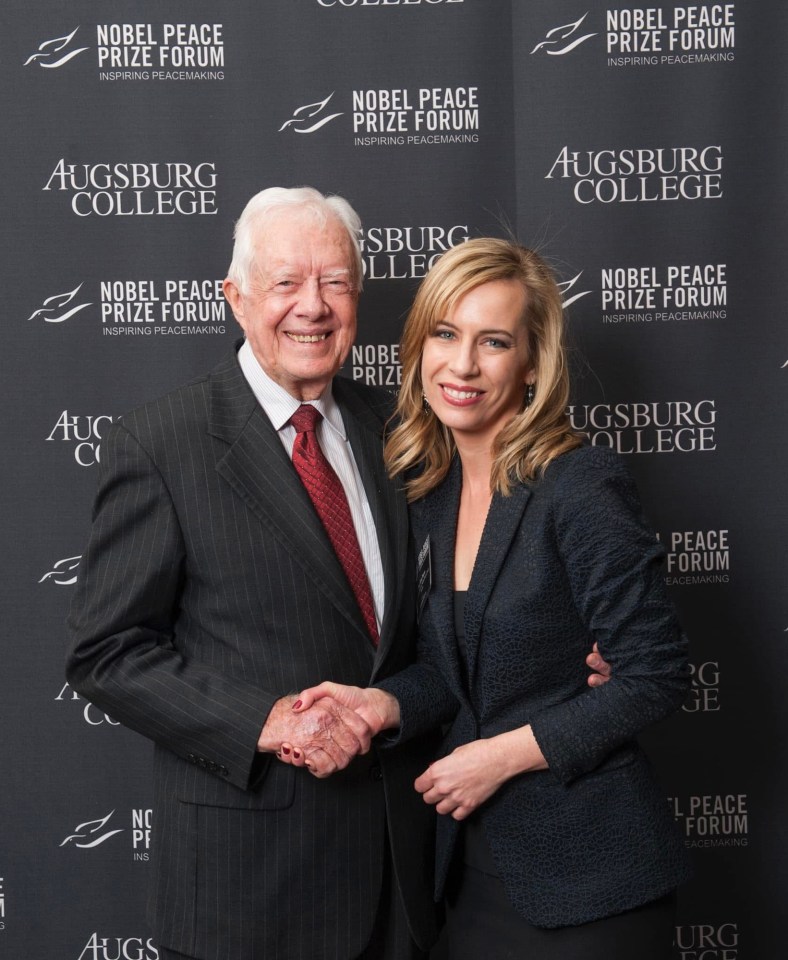
I had the extraordinary opportunity to spend some time with President Carter when I was the Executive Director of the Nobel Peace Prize Forum. In 2015, President Carter spoke at the Forum on his new book A Call to Action: Women, Religion, Violence, and Power, moderated by the incredible peace negotiator and signatory of the 1998 Good Friday Peace Agreement, Monica McWilliams.
In President Carter’s 2002 Nobel Peace Prize acceptance speech he foreshadowed and warned us of the dangers of wars increasingly fought – not on a traditional battlefield – but across civilian populations. At the time of the rise of social media and global communications, he warned in his acceptance speech of not harnessing the power of technological advances in communication to advance international understanding and peace. He also emphasized that though imperfect the United Nations is essential to the preservation of peace and change without violence. He said:
“Instead of entering a millennium of peace, the world is now, in many ways, a more dangerous place. The greater ease of travel and communication has not been matched by equal understanding and mutual respect. There is a plethora of civil wars, unrestrained by rules of the Geneva Convention, within which an overwhelming portion of the casualties are unarmed civilians who have no ability to defend themselves. And recent appalling acts of terrorism have reminded us that no nations, even superpowers, are invulnerable. It is clear that global challenges must be met with an emphasis on peace, in harmony with others, with strong alliances and international consensus. Imperfect as it may be, there is no doubt that this can best be done through the United Nations…not merely to preserve peace but also to make change, even radical change, without violence.”
He ended his Nobel Peace Prize lecture with a sentiment that rings true especially today:
“We will not learn how to live together in peace by killing each other’s children. The bond of our common humanity is stronger than the divisiveness of our fears and prejudices. God gives us the capacity for choice. We can choose to alleviate suffering. We can choose to work together for peace. We can make these changes – and we must.”
 International Center for Dialogue and Peacebuilding